



In the News–Crisis Management
CMO Today: Omnicom’s Clients Unbunde Digital Buys; Starbucks Shuts Stores For Racial-Bias Training; YouTube Addresses Creators
Lara, O’Reilly, The Wall Street Journal’s CMO Today, April 18, 2018
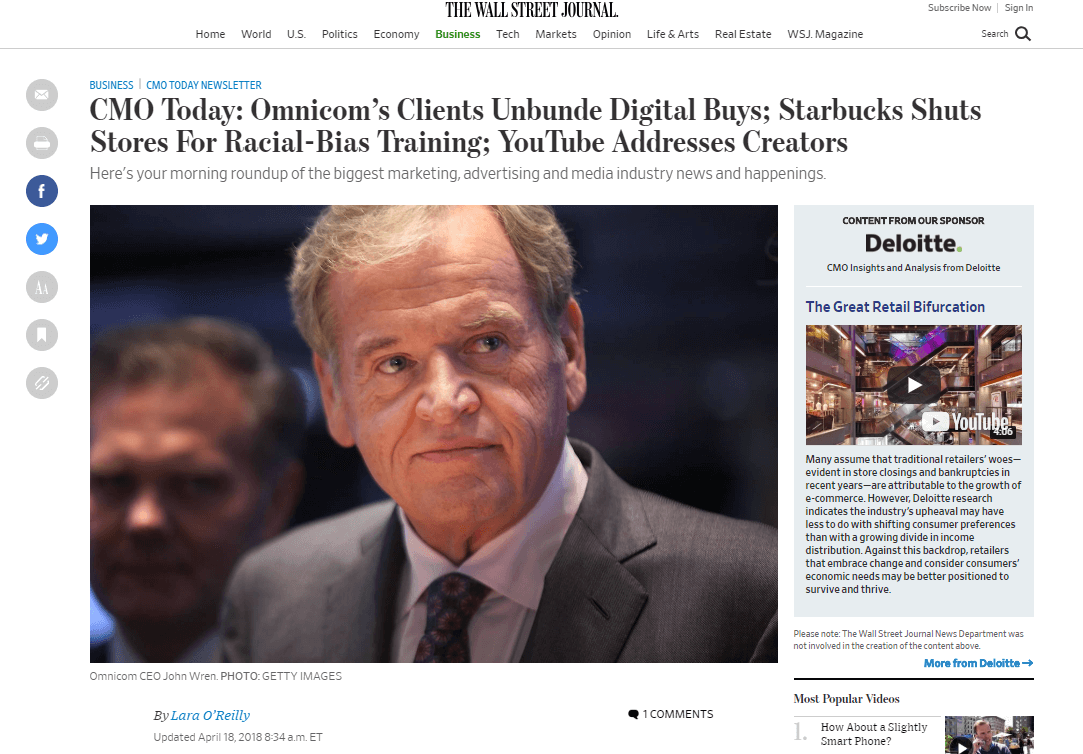
Starbucks made headlines this weekend after finding itself at the receiving end of a backlash when two black men were arrested at a downtown Philadelphia location. On Tuesday, they announced they will close all their company-owned U.S. stores on the afternoon of May 29 for racial-bias training, a move that some might compare to when Chipotle closed its stores to hold a national staff meeting about food safety.
But in Starbucks’ case, the company isn’t just applying a Band-Aid to an unraveling crisis, but defining best practice and a leadership position, according to Davia Temin. “Starbucks is defining a new level of seriousness in crisis response. It is a unique step—not one right out of some PR playbook—that both feels and appears to be honest and real.” […read more]
How Did Facebook CEO Mark Zuckerberg Do? Crisis-Management Experts Weigh In
John Simons and Vanessa Fuhrmans, The Wall Street Journal, April 11, 2018
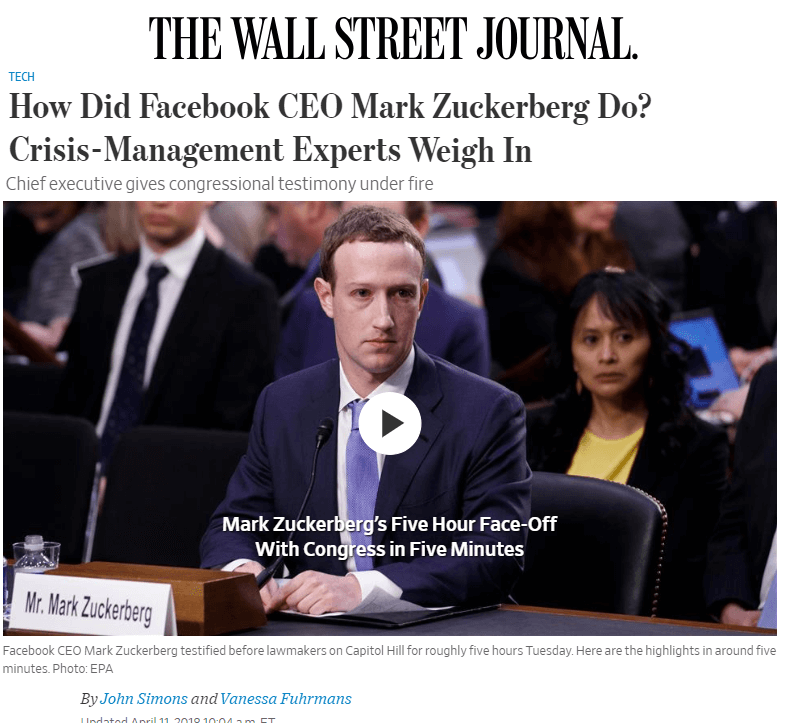
Facebook Inc. CEO Mark Zuckerberg testified in front of U.S. Congress on Tuesday afternoon. How did he do under fire? Crisis-management expert Davia Temin weighed in.
I think he gets an A-plus, considering where he started. He took responsibility for the mistakes he made. He stood up to the criticism and he didn’t deny it. What would infuriate the American people would be to deflect it, to seem holier than thou. He didn’t go that route.
He did not get cowed by the phalanx of photographers in the beginning, and that’s important. When you sit in that chair and you look out at the rows of photographers snapping pictures at you, that is a very daunting moment.
The apology tour beforehand was not as effective. You need to show you have a grand understanding of the damage that was done, and I think he began to do that. […read more]
How Mark Zuckerberg can prep to be Congress’s ‘whipping boy’
Matt Kwong, CBC News, April 9, 2018
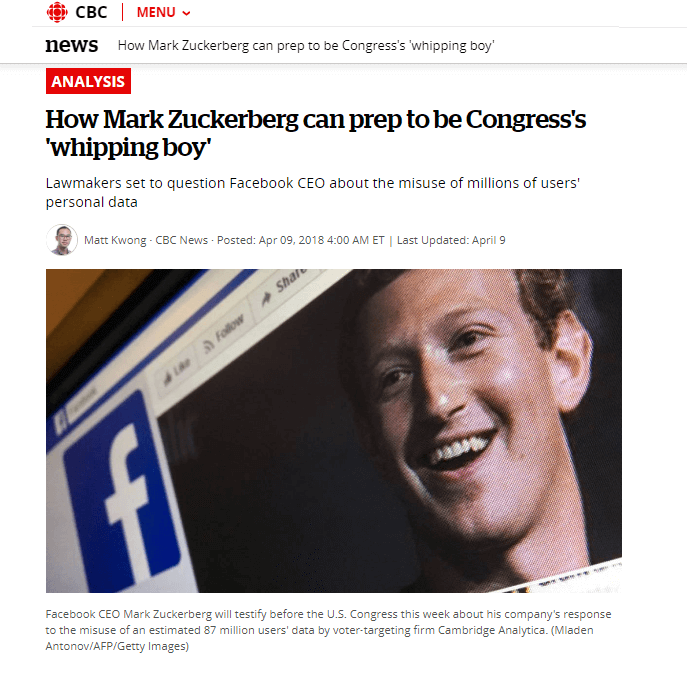
Keep your cool, Mark Zuckerberg, because this could get ugly. Show deference. Take your lumps. Watch your tone. Rehearse, rehearse, rehearse. Draw lessons from previous CEO flameouts and triumphs.
General Motors CEO Mary Barra survived a bruising testimony in 2014 about the ignition-switch recall, and remains in her executive role to this day.
“She’s the model of how to take responsibility, how to be authentic, to be real, to not shirk” the scandal, said Davia Temin, a New York-based CEO coach who also prepares them for testimony. “She had a plan to fix it even though it had been a matter of months that she’d been in the role and it wasn’t necessarily of her making. She was brilliant.”
Barra’s ownership of the problem likely helped bring the scandal to a close in the public’s minds, Temin said.
“Frankly, if I were working with Zuckerberg, I would bring out those tapes of Mary.” […read more]
Leadership at the Crossroads Part 3: Courage to Speak Boldly When it Counts.
Gloria Feldt, The Sum – The Meaning of This Week, April 2, 2018
This article’s author asks readers whether they plan to delete their Facebook accounts in the wake of the controversy that threatened to unseat the social media giant. She also looks to Davia Temin’s Forbes post about what Mark Zuckerberg should have done and said.
“Facebook has been larger than life in our worlds for over a decade,” said Davia Temin. “We have trusted it enough to bring it into our homes and bedrooms, our commutes and workplaces, our friendships and our families until it has almost reached ubiquity. So Facebook’s responses to such a larger-than-life issue as this — the possible dissolution of our sovereign decision-making process — must be bigger than life, too. And far, far better.” […read more]
America’s Leadership Crisis: Davia Temin
Richard Davies, How Do We Fix It?, March 30, 2018
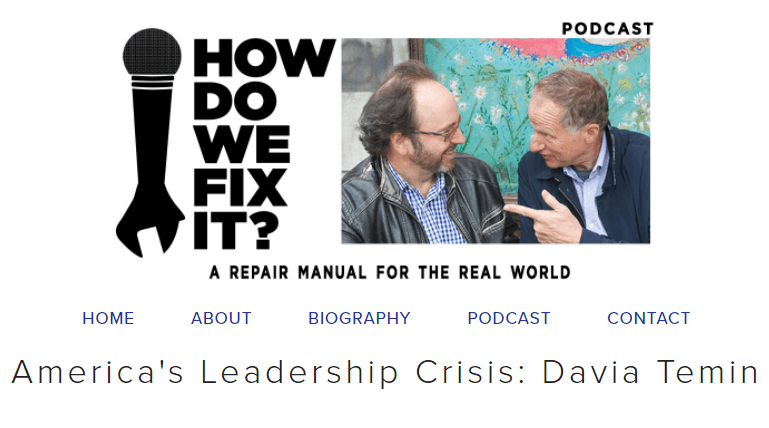
With turmoil and never-ending drama in the White House, and record numbers of departures from top levels of the Trump Administration, it is safe to say that America is facing a leadership crisis.
This episode’s guest, Davia Temin, looks at how leaders can avoid the mistakes and embarrassment that could ruin their reputation, lead to their downfall and cause their employees and associates great harm.
She speaks from a place of deep experience and passion about the crucial importance of ethics, honesty and diversity, as well as the need for leaders to communicate quickly and clearly, especially in times of crisis. We learn about the do’s and don’ts of crisis communications as well as the benefits of coaching and training. […read more]
Zuckerberg built an instant gratification machine — but took his time addressing the trouble it’s caused
Jena McGregor, The Washington Post, March 22, 2018

After Mark Zuckerberg broke his silence Wednesday about the mushrooming Cambridge Analytica scandal, it’s hard to argue the Facebook founder and CEO has said too little.
Zuckerberg wrote a 935-word Facebook post Wednesday where he said “we have a responsibility to protect your data, and if we can’t then we don’t deserve to serve you,” outlining steps the company was taking following blockbuster reports about user data being scraped without their consent. He sat for interviews with the New York Times, Wired, tech publication Recode and a rare on-camera interview with CNN.
But despite the Facebook post and parade of media interviews, crisis experts argue Zuckerberg’s personal response came much too late.
“The higher the stakes, the quicker you want to plant your flag,” said Davia Temin. “And these stakes are arguably the highest of any crisis we’ve seen in a long time for a corporation.” […read more]
3 Important Lessons From Facebook’s Deepening PR Crisis
Ari Zoldan, Inc., March 22, 2018
Facebook hasn’t exactly been sitting pretty in the court of public opinion, even if many who were holding its feet to the fire over unscrupulous “fake news” stories and Russian-bought political advertisements were still using the social media platform. But the storm was perhaps breaking, and brighter skies — or at least neutral ground — seemed on the horizon.
Then Cambridge Analytica happened.
Facebook CEO Mark Zuckerberg released a statement that amounted to an acceptance of responsibility, and promised that the company would be making changes to its data security policies.
However, the response came four days after news broke of the scandal.
“In today’s world, I believe you have 15 minutes to address some kind of crisis when it emerges over social media,” Davia Temin told MarketWatch. Customers don’t like to be left in the dark. A quick repsonse is key to rebounding. […read more]
Opinion: Facebook’s Zuckerberg had 15 minutes to respond to privacy crisis — he took four days
Howard Gold, MarketWatch, March 22, 2018
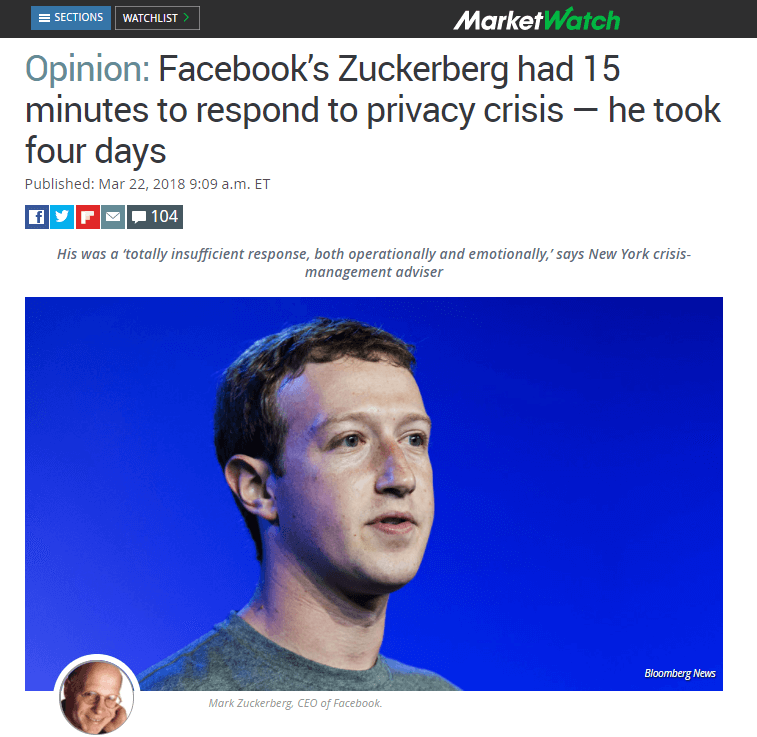
Facebook’s Mark Zuckerberg finally broke his silence late Wednesday afternoon.
In a long and technical statement posted on his Facebook page, the CEO addressed the massive misuse of personal information in which a researcher was able to release data on 50 million Facebook users without their consent to Cambridge Analytica, a firm that worked closely with the Trump campaign during the 2016 presidential election.
Davia Temin said Facebook missed its chance to shape the narrative in its favor, and Zuckerberg’s statement did nothing to change that. “This is a totally insufficient response, both operationally and emotionally,” she said. “Yes, it is prescriptive, yet strangely hollow, limited, unemotional, and lacking any form of apology.” She added that it made Facebook look like it was “fiddling while the world is burning.” […read more]
Nike Scandal Threatens Its Image With Women at Tumultuous Time
Matthew Townsend, Bloomberg, March 22, 2018
It’s never a good time for companies to grapple with a scandal over sexist behavior. At Nike Inc., it’s especially awkward given its ambition to target female shoppers.
The world’s largest sports brand expects much of its future growth to come from selling more sneakers and gear to young women. And fresh concerns about a locker-room mentality could hurt Nike’s reputation with a demographic group that it desperately needs. That risk looms over a company that saw two high-profile executives step down last week amid a broader review of misconduct.
“It’s an enormous reputational risk,” said Davia Temin. “We know millennials want to work for places that have a higher purpose. They are going to put their buying power in the same place.”
The company is especially ripe for being deemed phony and inauthentic, she said. Unlike some other businesses caught up in the #MeToo movement — a push to improve treatment of women, especially in the workplace — Nike has marketed itself as a champion of female empowerment, Temin said. Anything that undercuts that image could be a brand killer. […read more]
Institutional investors eye gun control
Ben Ashwell, Institutional Investor, March 19, 2018
Until now, gun control in the US has only been a concern from an IR perspective in terms of faith-based investors, but the high-profile public debate since the Parkland school shooting in Florida may be changing that. Several large financial institutions have in recent weeks broken with precedent and publicly committed to engagement with portfolio companies around gun control, signaling that this may join human rights and political lobbying as a prominent social issue for investors.
Davia Temin says gun control and the anti-sexual assault #MeToo movement has shown the power of consumers harnessing social media to create a targeted movement on ESG issues. “All of a sudden on both issues we’ve reached a tipping point on sentiment, with what’s happened on social media showing that the public’s mood is changing. So the real exposure here is for boards to understand the values of their customer base and their core audience, and have their own set of values to live up to. The people who think they can just rearrange the deckchairs on the Titanic are in denial as to how serious this public reevaluation of issues is.” […read more]
More News Articles