



In the News–Social Media
Leadership at the Crossroads Part 3: Courage to Speak Boldly When it Counts.
Gloria Feldt, The Sum – The Meaning of This Week, April 2, 2018
This article’s author asks readers whether they plan to delete their Facebook accounts in the wake of the controversy that threatened to unseat the social media giant. She also looks to Davia Temin’s Forbes post about what Mark Zuckerberg should have done and said.
“Facebook has been larger than life in our worlds for over a decade,” said Davia Temin. “We have trusted it enough to bring it into our homes and bedrooms, our commutes and workplaces, our friendships and our families until it has almost reached ubiquity. So Facebook’s responses to such a larger-than-life issue as this — the possible dissolution of our sovereign decision-making process — must be bigger than life, too. And far, far better.” […read more]
America’s Leadership Crisis: Davia Temin
Richard Davies, How Do We Fix It?, March 30, 2018
With turmoil and never-ending drama in the White House, and record numbers of departures from top levels of the Trump Administration, it is safe to say that America is facing a leadership crisis.
This episode’s guest, Davia Temin, looks at how leaders can avoid the mistakes and embarrassment that could ruin their reputation, lead to their downfall and cause their employees and associates great harm.
She speaks from a place of deep experience and passion about the crucial importance of ethics, honesty and diversity, as well as the need for leaders to communicate quickly and clearly, especially in times of crisis. We learn about the do’s and don’ts of crisis communications as well as the benefits of coaching and training. […read more]
Zuckerberg built an instant gratification machine — but took his time addressing the trouble it’s caused
Jena McGregor, The Washington Post, March 22, 2018

After Mark Zuckerberg broke his silence Wednesday about the mushrooming Cambridge Analytica scandal, it’s hard to argue the Facebook founder and CEO has said too little.
Zuckerberg wrote a 935-word Facebook post Wednesday where he said “we have a responsibility to protect your data, and if we can’t then we don’t deserve to serve you,” outlining steps the company was taking following blockbuster reports about user data being scraped without their consent. He sat for interviews with the New York Times, Wired, tech publication Recode and a rare on-camera interview with CNN.
But despite the Facebook post and parade of media interviews, crisis experts argue Zuckerberg’s personal response came much too late.
“The higher the stakes, the quicker you want to plant your flag,” said Davia Temin. “And these stakes are arguably the highest of any crisis we’ve seen in a long time for a corporation.” […read more]
3 Important Lessons From Facebook’s Deepening PR Crisis
Ari Zoldan, Inc., March 22, 2018
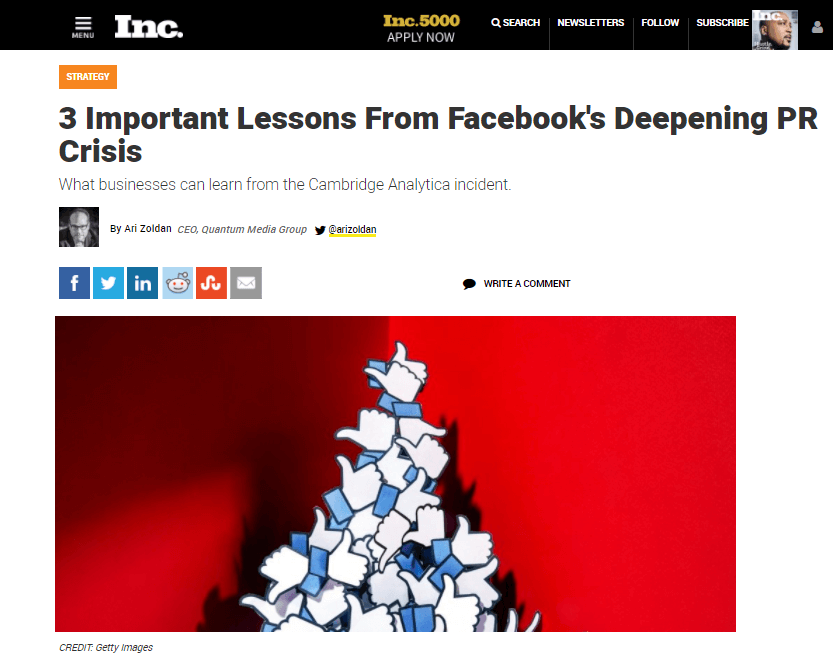
Facebook hasn’t exactly been sitting pretty in the court of public opinion, even if many who were holding its feet to the fire over unscrupulous “fake news” stories and Russian-bought political advertisements were still using the social media platform. But the storm was perhaps breaking, and brighter skies — or at least neutral ground — seemed on the horizon.
Then Cambridge Analytica happened.
Facebook CEO Mark Zuckerberg released a statement that amounted to an acceptance of responsibility, and promised that the company would be making changes to its data security policies.
However, the response came four days after news broke of the scandal.
“In today’s world, I believe you have 15 minutes to address some kind of crisis when it emerges over social media,” Davia Temin told MarketWatch. Customers don’t like to be left in the dark. A quick repsonse is key to rebounding. […read more]
Opinion: Facebook’s Zuckerberg had 15 minutes to respond to privacy crisis — he took four days
Howard Gold, MarketWatch, March 22, 2018
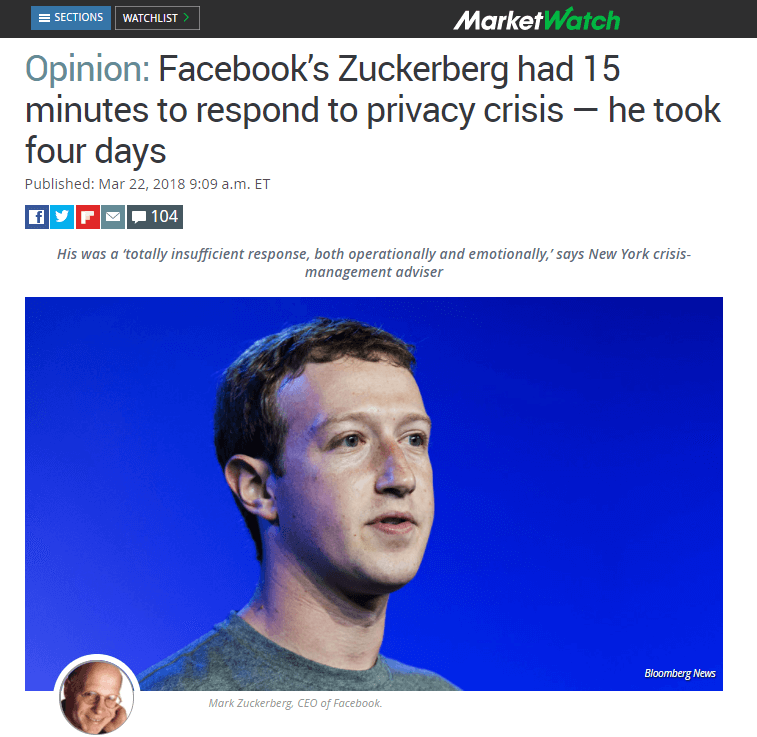
Facebook’s Mark Zuckerberg finally broke his silence late Wednesday afternoon.
In a long and technical statement posted on his Facebook page, the CEO addressed the massive misuse of personal information in which a researcher was able to release data on 50 million Facebook users without their consent to Cambridge Analytica, a firm that worked closely with the Trump campaign during the 2016 presidential election.
Davia Temin said Facebook missed its chance to shape the narrative in its favor, and Zuckerberg’s statement did nothing to change that. “This is a totally insufficient response, both operationally and emotionally,” she said. “Yes, it is prescriptive, yet strangely hollow, limited, unemotional, and lacking any form of apology.” She added that it made Facebook look like it was “fiddling while the world is burning.” […read more]
Navigating the United PR crisis
Amara Walker, CNNi, April 11, 2017
Amara Walker talks with public relations expert Davia Temin about United Airline’s handling of their latest crisis that sparked worldwide outrage, in which a passenger was dragged off the airline when he wouldn’t give up his seat on an overbooked flight, and how they can recover from the blow to their reputation.
To watch the interview on CNN, CLICK HERE.
PR Nightmares: United Fiasco Among Worst Corporate Gaffes
Christopher Palmeri and Jeff Green, Bloomberg, April 11, 2017
When it comes to bad public relations, it’s pretty tough to top the sight of a United Airlines passenger being dragged, bloodied and screaming, from a flight.
The incident, including two attempts at apology by Chief Executive Officer Oscar Munoz, has been airing on cable TV and raging on social media for days. But the fiasco is hardly the first self-inflicted corporate blunder. Munoz can take comfort that it’s happened to others, and in many cases the bosses didn’t lose their jobs, as our PR Tales From Hell illustrate.
Over Easter week in 2009, two Domino’s Pizza employees in North Carolina posted a video on YouTube showing one sticking cheese up his nose and pretending to sneeze on a customer’s sandwich. With the clip reaching one million views, management fired the employees, sanitized the store and produced its own video with a formal apology from President Patrick Doyle.
The company’s response was to show outrage and take action, said Davia Temin, head of the New York-based crisis-management firm Temin & Co. CEO David Brandon kept his job and now runs Toys “R” Us Inc. Doyle succeeded him. […read more]
Crisis of the Week: Hacked Twitter Account Gives McDonald’s Indigestion
Ben DiPietro, The Wall Street Journal’s Risk & Compliance Journal, March 27, 2017
The crisis magnifying lens puts it focus on McDonald’s Corp. after a message was sent on the company’s Twitter account calling President Donald Trump “a disgusting excuse of a President” and trolling him by saying he has “tiny hands.” The White House did not comment, but some supporters of the president called for a boycott of the burger chain.
McDonald’s said it was notified by Twitter that its account was hacked. McDonald’s deleted the tweet, secured its account and said an internal investigation found the account had been hacked by “an external source.” The company put out a statement apologizing that “this tweet was sent through our corporate McDonald’s account.”
The experts evaluate how well McDonald’s handled this crisis.
“The fake tweet sent from McDonalds’ Twitter account on March 16 that disparaged President Donald Trump catapulted the company into the land of alt-tweetdom,” said Davia Temin. “Today, as companies and individuals alike struggle to delineate truth from fiction in public discourse, McDonalds had an immediate imperative to let the public know it had not officially sent the insulting tweet. It had to act quickly to set the record straight, before it even knew what really had happened. It couldn’t let a lie stand. It did an excellent job.” […read more]
Four Years of Living Dangerously: CEOs Brace for the Trump Era
Matt Townsend, Bloomberg Technology, December 19, 2016
As president-elect, Donald Trump is pro-business and a champion of corporate tax cuts. And anti-free trade and a big-company bully.
That’s a disorienting mix for chief executive officers trying to suss out whether Trump in the White House will be a blessing or bad luck. Planning ahead’s no easy task when the next commander in chief is a guy with a hair-trigger Twitter finger who touts policies that could both help and hurt U.S. companies.
“It will be a fascinating experience to see how things that have worked inside global organizations translate to the political arena,” said Davia Temin, founder of the crisis-management company Temin & Co.
For all that, the victim of a Twitter pounce must be careful, she said. “Never start a press war with someone who can outgun you.” […read more]
Donald Trump just tweeted about you — what do you do?
Cory Schouten, CBS MoneyWatch, December 9, 2016
A high-profile dustup this week between Boeing CEO Dennis Muilenburg and President-elect Donald Trump has left corporate board members and CEOs on edge.
Shortly after news emerged that Muilenburg had questioned Trump’s stance on trade in a speech in Chicago, the president-elect fired back with tweets threatening to cancel the company’s contract to build two new Air Force One jets. Boeing’s stock fell but eventually recovered after the CEO and Mr. Trump made nice on a phone call. (Boeing also pledged $1 million toward the inauguration festivities.)
The exchange was a cautionary tale for business leaders who are accustomed to a certain way of interacting with political leaders, said Davia B. Temin, president and CEO of a boutique management consultancy focusing on crisis and reputation management.
Temin, who advises several industrial, biotech and financial firms, including Fortune 500 companies, talked with CBS MoneyWatch about the implications of the Trump-Muilenburg exchange. […read more]
More News Articles