


In the News–Leadership & Strategy
Is your board risk-ready?
Michele Wucker, Strategy + Business, March 11, 2020
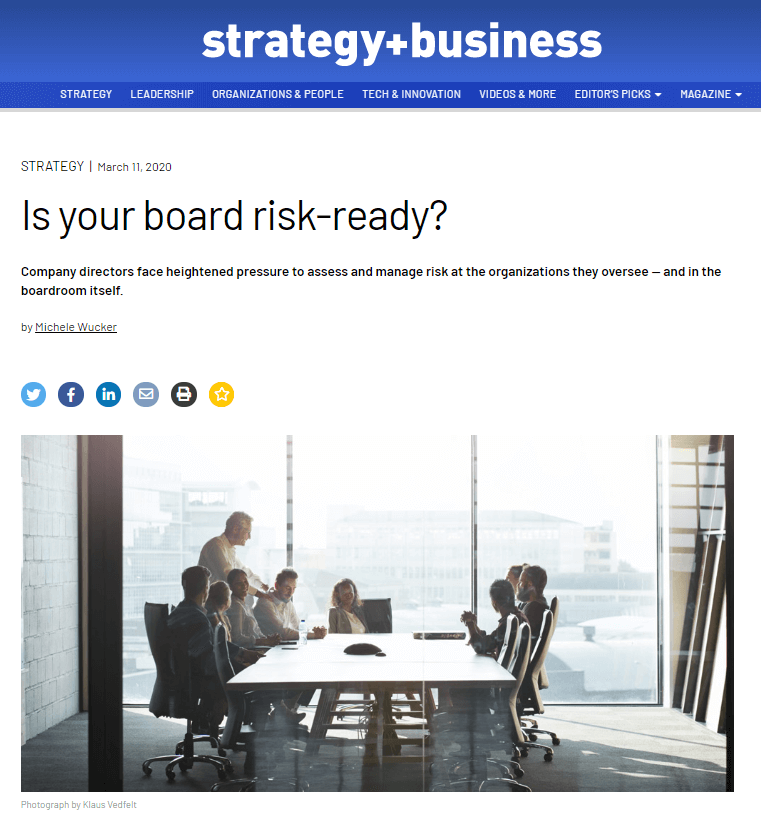
Your company’s board of directors is charged with reviewing all kinds of risks to the corporation. But how well prepared are its members to do so? How ready are directors to evaluate, communicate, and act on risks — and thus to better ensure that their companies are doing a good job? A great deal rides on the answers to these questions.
Understanding the risk attitudes of directors as individuals and as a whole can make all the difference if a risk materializes into a full-blown crisis. Davia Temin, founder of the New York–based crisis management firm Temin and Company, said it’s essential to understand and improve a board’s risk reaction dynamics during times of calm. “It’s better to fix the fissures on a board ahead of time because every fissure will explode in a crisis,” she said.
She recommends boards do an annual risk survey to determine how attuned different directors are to various risks. Crisis scenario games can shed light on differences among board members in their responses to stress and risks, and help board chairs to identify ahead of time which directors they might lean on most when — not if — a crisis hits. In fact, PwC’s 2019 survey found that the percentage of directors participating in crisis management tabletop exercises doubled since last year, from 28 percent to 56 percent. […read more]
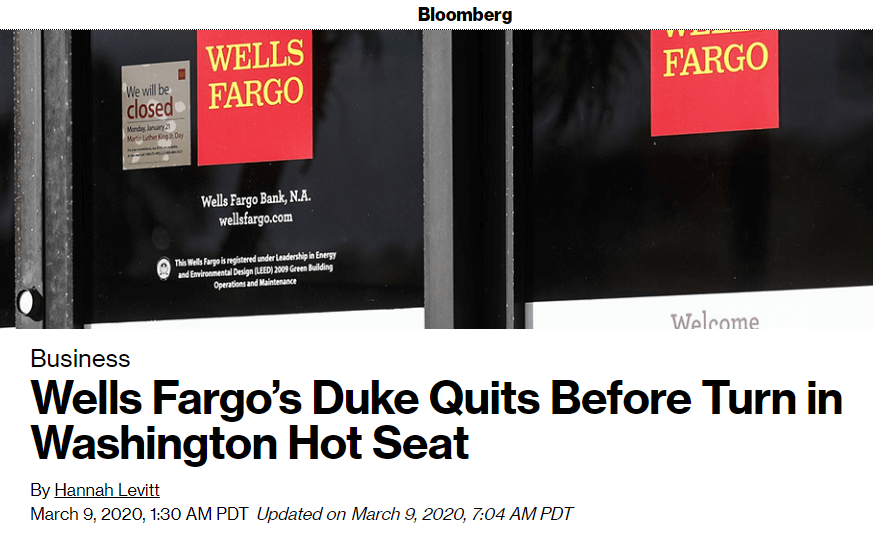
Wells Fargo’s Duke Quits Before Turn in Washington Hot Seat
Hannah Levitt, Bloomberg, March 9, 2020 »
Wells Fargo & Co. Chair Betsy Duke resigned from the company’s board ahead of a dramatic congressional hearing set for this week, succumbing to the same political pressures that have claimed multiple former leaders of the bank.
The lender said Monday that board member Charles Noski will replace Duke as chair. Duke faced a growing chorus of calls for her departure after Democrats atop the House Financial Services Committee issued a scathing report last week on the bank’s response to a series of consumer scandals.
 The latest set of hearings begins Tuesday with an appearance by CEO Charlie Scharf, less than five months into his tenure. The committee will seek his thoughts on next steps for what it calls “the bank that broke America’s trust.”
Scharf is preparing to answer questions on what he’s doing to get back in the good graces of customers, regulators and the public. He’s met with nearly half the House Financial Services Committee, including Waters, since taking over in October, people with knowledge of the meetings said.
He’ll be able to point to changes he’s made since taking the helm, including adding new leaders and settling past probes. And he can tout the bank’s recent announcements on minimum-wage increases, limited-fee bank accounts and lending to recipients of the Deferred Action for Childhood Arrivals program.
Scharf “can come on as a hard-nosed leader who is going to do the bidding of the public and fix things,” Davia Temin, founder of crisis consultancy Temin & Co., said in an interview. “America still loves a comeback kid.”
The board members faced a different task, Temin said. “It’s harder to be part of the problem and then the solution.” […read more]
Victoria’s Secret Faces New Sexual Misconduct Allegations
Jordyn Holman and Kim Bhasin, Bloomberg, February 3, 2020
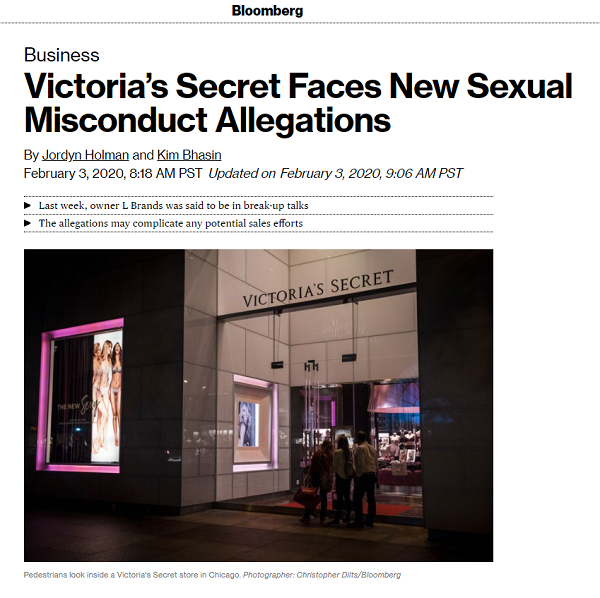
New allegations of sexual misconduct have surfaced at Victoria’s Secret as the brand tries to remake its image after years of scandal and slumping sales.
Female models and executives were bullied and harassed for decades at the lingerie chain, evidence of an “entrenched culture of misogyny,” according to a New York Times investigation published this weekend.
The revelations come days after reports that L Brands Inc., owner of the troubled retailer as well as Bath & Body Works, was in talks to break up the company and that longtime Chief Executive Officer Les Wexner could step down.
***
Davia Temin, CEO of crisis consulting firm Temin and Company, said the problems at Victoria’s Secret have become endemic, and it may need a new owner to survive. Patching up the brand by tweaking advertising won’t be enough, she said.
“Unfortunately, now Victoria’s Secret’s brand has gone to sleazy from sexy,” Temin said. “And no re-brand is going to fix that.” […read more]
Employees Speak Out—Against Their CEOs
Rachel Feintzeig, Charity L. Scott and Sharon Terlep, The Wall Street Journal, February 1, 2020
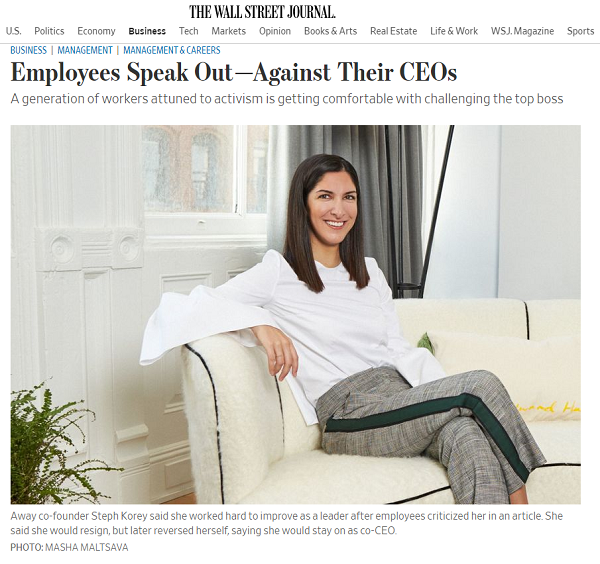
Chief executives routinely face barbs from investors and the media. Now some are dealing with criticism from a group closer to home: their own staffs.
Two recent workplace sagas—at online luggage seller Away and G/O Media, the publisher of former Gawker Media sites such as Deadspin and Gizmodo—highlight the more outspoken scrutiny that some leaders face from employees. At both companies, disgruntled workers led efforts to pressure their chief executives over behavior or decisions they didn’t like.
The top boss used to be more shielded from in-house criticism. With some exceptions, discontented employees tended to grumble among themselves or at a town hall meeting. They let labor leaders do the toughest talking, usually in pursuit of better wages or job security.
But at a time when digital forums like Slack and others are proliferating, workers aren’t just pressing employers to develop a stronger social conscience. They are taking leaders to task for their management style and, in some cases, calling for their jobs.
***
Companies are still trying to figure out how to handle crises born out of more openly critical employees, said Davia Temin, CEO of Temin and Co., a New York-based reputation and crisis-management firm.
“This is a new competency,” Ms. Temin said, “and I don’t think that it’s just a normal leadership competency that you learn in business school.” […read more]
Wayfair Employees Protest in Boston Over Border Camp Sales
Sammy Criscitello, Janet Wu and Jordyn Holman, Bloomberg, June 26, 2019
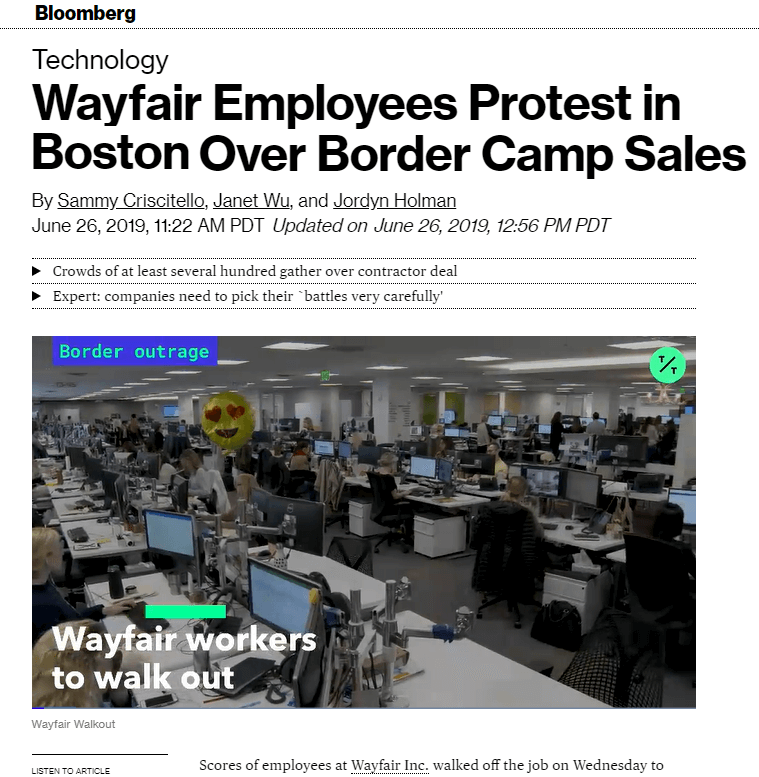
Scores of employees at Wayfair Inc. walked off the job on Wednesday to protest the online retailer’s sale of beds to contractors furnishing border camps for asylum seekers.
Wayfair is just the latest company to face intense public scrutiny from its employee base over political issues, according to Davia Temin, head of the New York-based crisis-management firm Temin & Co.
“Once you are in that spotlight, it will have an impact,” Temin said ahead of the protest. “It puts them on the wrong side of their customer base who are generally young and probably a little bit more activist.” […read more]
Have We Reached the Point of #MeToo Malaise?: The Broadsheet
Claire Zillman and Emma Hincliffe, Fortune, The Broadsheet, June 19, 2019
New data from crisis consulting firm Temin and Company finds that last month saw 12 high-profile allegations. That’s the lowest monthly total since claims against movie mogul Harvey Weinstein ignited the #MeToo movement in the fall of 2017 and a dramatic drop from a peak of 143 last October.
In explaining the trend, Davia Temin, the consultancy’s CEO, cited a few factors: a backlash against the movement, more sophisticated campaigns to counter accusations, and improved corporate resources that are placating the aggrieved. […read more]
Sexual harassment allegations are down sharply since Harvey Weinstein first accused
Megan Cerullo, CBS News, June 19, 2019
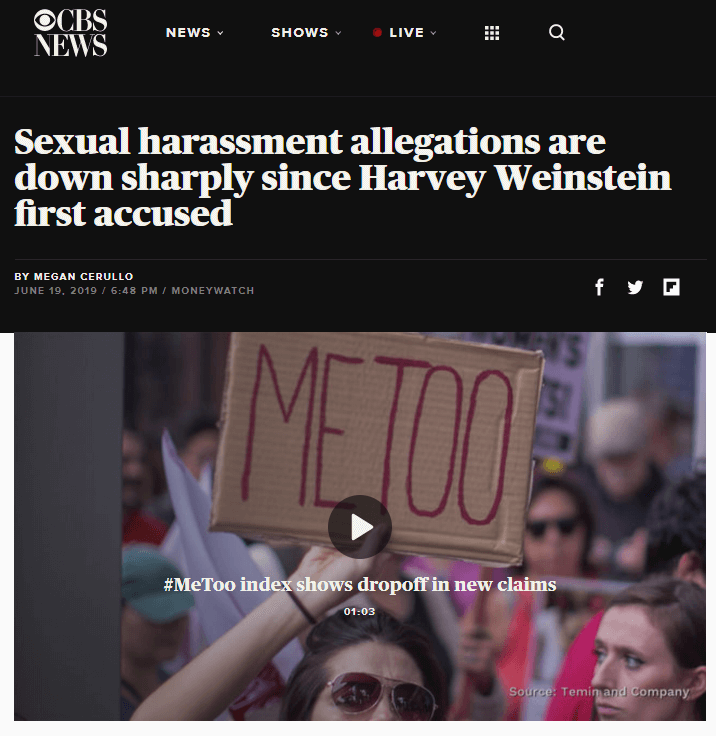
Good news, perhaps, for victims of harassment in the workplace. The number of highly publicized #MeToo accusations dropped to the lowest level last month since peaking in October 2017, when former Hollywood studio chief Harvey Weinstein was first accused of sexual harassment. That’s according to the “#MeToo Index,” which tracks what it calls “high-profile” accusations of sexual misconduct in entertainment, media, politics and other employment sectors.
Twelve such accusations surfaced in May, down from 143 in October 2017, according to Temin and Company, a corporate reputation management and public relations firm that maintains the #MeToo Index. Temin attributes the steep drop in public accusations to a combination of factors, including companies’ improved internal reporting systems and procedures for handling complaints.
“Organizations have become more savvy, so when they hear complaints they are quicker to investigate, address and handle them in some way, as opposed to ignore them,” Davia Temin, the firm’s CEO, said. […read more]
‘A new era’: Trump and 2020 hopefuls are singling out more American companies by name
Jena McGregor, The Washington Post, June 13, 2019
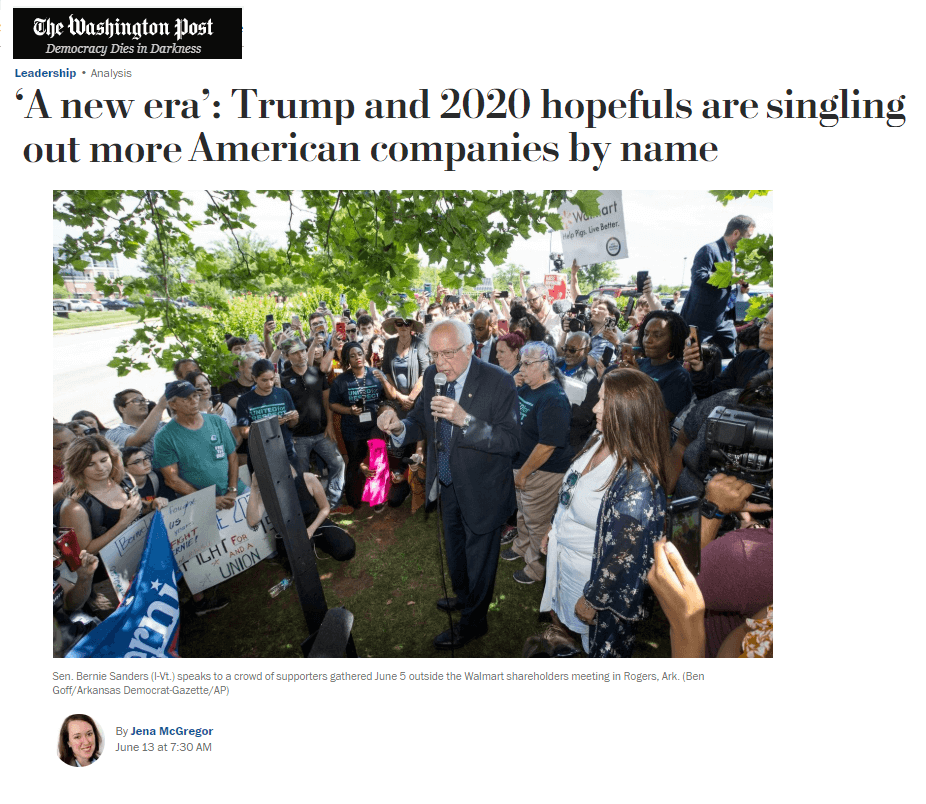
On Monday, after Raytheon and United Technologies announced merger plans, President Trump weighed in again with an opinion about American corporate business decisions, telling CNBC he was “a little concerned” the defense contractor and industrial technology giant’s merger could result in less competition if they become “one big fat beautiful company.” It was the latest in a long string of examples of Trump — whether by tweet or by tirade — singling out American companies.
But the president has been joined more often in recent months by 2020 Democratic presidential candidates who are also increasingly calling out companies by name, directly challenging American businesses in a way that historians and communication experts say underscores a new era.
Communications experts advised companies not to get into Twitter wars, to be responsive but not respond in kind, and to prioritize connecting with White House or legislative staffers early on when making announcements that could come under fire. In most cases, companies should use the opportunity to explain their story or strategy again rather than fight.
“Don’t escalate, don’t shoot back,” said Davia Temin, a communications and management coach on reputation issues. “The last thing an awful lot of people want is a one-upmanship match between the president or presidential candidates and an individual company.” […read more]
The Doyenne of ‘Courage’ in Crisis
Bridget Paverd, PRSA, May 13, 2019

I spent a morning in New York City with Davia Temin last week.
While respectful of the knowledge of others, and always open to learning, there are just so many accomplished professionals that I am seldom blown away meeting a specialized superstar.
Davia is an exception.
Davia and I discussed crisis as we see it now, in 2019…. A world of ‘alternative facts’ and the MeToo movement. We shared war stories. I wanted to write down every word she said – she was so generous with advice. We talked about the value of the truth. And of listening. Of “hearing” both clients and audiences and moving our clients into recovery as quickly as possible.
Davia Temin has shaped, and continues to define, contemporary crisis communication. All of us who work in reputation management have been influenced by her leadership. Even those who don’t know her name follow her best practices. Barely a month goes by that she is not quoted in major media. […read more]
Temps at the top
Nancy Marshall-Genzer, Marketplace, April 23, 2019

Right now, the Trump administration has acting heads at the Defense Department, Homeland Security, the Small Business Administration, and the Office of Management and Budget. By the time you finish reading this story, there could be more. And that’s just the way President Trump likes it, as he told CBS’s “Face the Nation” in February.
“I like ‘acting’ because I can move so quickly,” he said. “It gives me more flexibility.”
It’s the kind of flexibility that’s increasingly on display in the private sector. Intel appointed Robert Swan as interim CEO last June. Last month, Wells Fargo announced that its general counsel, C. Allen Parker, would become interim CEO and president. J. Crew, Comscore and Herbalife have also brought on interim CEOs this year.
Davia Temin coaches interim executives. She says they have a tough job.
“You’ve got the title — almost,” she said. “You’ve got the responsibility — almost. You are acting as if you are the CEO, but when it comes to long-term strategy and planning and action and vision and mission, you don’t have that nod.” […read more]
More News Articles