



Must Reads
There is so much to read, so much to know, so many sources to follow. And the volume of news and information just keeps growing exponentially. How to keep up? Even more, how to rediscover the serendipity of learning something new and interesting for its own sake?
Here, for your enjoyment and interest, are the articles Temin and Company considers “must reads.” They are primarily on the topics of reputation and crisis management, the media, leadership and strategy, perception and psychology, self-presentation, science, girls and women, organizational behavior and other articles of interest.
They are listed below with the most recent articles first, and to the side, by category.
We hope you enjoy them and would appreciate your comments. And whenever you have any favorite articles for us to add, please let us know so that we might include them for other readers to enjoy.
There is so much to read, so much to know, so many sources to follow. And the volume of news and information just keeps growing exponentially. How to keep up? Even more, how to rediscover the serendipity of learning something new and interesting for its own sake?
Here, for your enjoyment and interest, are the articles Temin and Company considers “must reads.” They are primarily on the topics of reputation and crisis management, the media, leadership and strategy, perception and psychology, self-presentation, science, girls and women, organizational behavior and other articles of interest.
They are listed below with the most recent articles first, and to the side, by category.
We hope you enjoy them and would appreciate your comments. And whenever you have any favorite articles for us to add, please let us know so that we might include them for other readers to enjoy.
Kyte Baby CEO issues two apologies in remote working row
Richard Quest, CNN’s Quest Means Business, January 24, 2024
Davia Temin joins CNN’s Richard Quest to discuss Kyte Baby CEO’s apologies for denying the remote work request from a mother whose baby is in the NICU.
“Take a loss, but do the right thing because perception matters…It’s doing the right thing, and sometimes that’s not the right thing for your pocket.”
11 Attributes To Look For In Your Crisis Manager
Leadership, “Reputation Matters,” Forbes, January 16, 2024
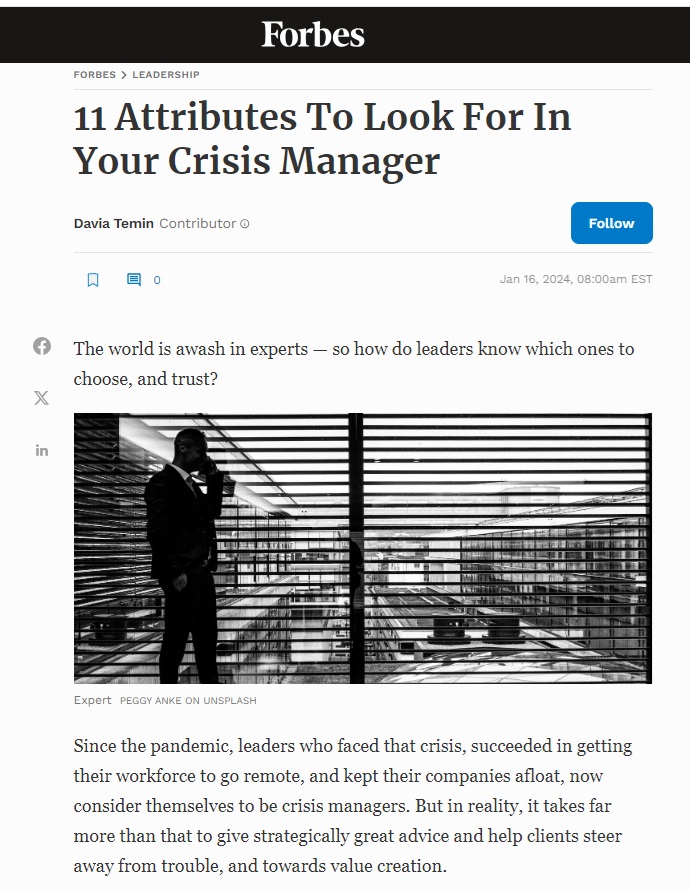
The world is awash in experts — so how do leaders know which ones to choose, and trust?
Since the pandemic, leaders who faced that crisis, succeeded in getting their workforce to go remote, and kept their companies afloat, now consider themselves to be crisis managers. But in reality, it takes far more than that to give strategically great advice and help clients steer away from trouble, and towards value creation.
In the first part of this two-part series we discussed how to judge judgment. After decades serving as a trusted strategy and crisis advisor to leaders in hundreds of different industries, settings, and situations, here are 11 stress-tested suggestions for how leaders can recognize whose advice to trust, and who to turn to in crisis. […read more]
Judging Judgment: How Can Leaders Know Whose Advice To Trust In Crisis Situations?
Leadership, “Reputation Matters,” Forbes, January 15, 2024
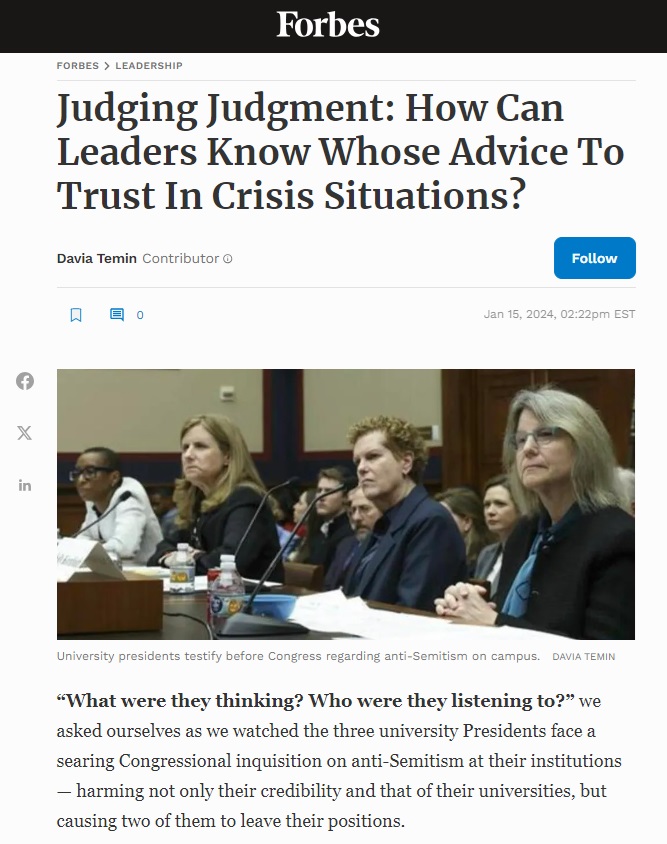
“What were they thinking? Who were they listening to?” we asked ourselves as we watched the three university Presidents face a searing Congressional inquisition on anti-Semitism at their institutions — harming not only their credibility and that of their universities, but causing two of them to leave their positions.
While the Presidents of MIT, University of Pennsylvania, and Harvard gave strong, elegant and convincing opening statements — all of which seemed strikingly similar — their advantage was dissipated during the questioning, which was notable for its toughness, but also for pushing the Presidents into a trap that was almost impossible to escape.
‘Yes or no’ they were told to answer by Representative Elise Stefanik, did the cries of “Intifada” on their campuses — taken to mean death to Israel and Jews — constitute bullying and harassment, and were thus against the rules of their universities?
The Presidents were basically asked the impossible question of the decade on college campuses — to choose between free speech and the banishment of hate speech that calls for violence. The question demanded strong, emotionally intelligent but institutionally decisive answers. And absolutely everyone knew that the question was coming. The need was for real answers, not verbal gamesmanship. Yet, the Presidents just were not prepared to answer the questions decisively and resonantly; they kept reverting back to the idea that there was no one answer — such bullying had to be taken “in context.” […read more]
JPMorgan settles with Jeffrey Epstein victims for $290 million
Nupur Anand, Lananh Nguyen, Luc Cohen and Jonathan Stempel, Reuters, June 12, 2023
JPMorgan Chase agreed to pay about $290 million to settle a class action lawsuit by Jeffrey Epstein’s victims, resolving a large part of litigation over the bank’s relationship with the disgraced financier.
Monday’s settlement follows months of embarrassing disclosures that JPMorgan ignored internal warnings and overlooked red flags about Epstein because he had been a valuable client.
Davia Temin, chief executive of crisis management firm Temin and Co, said settling rather than fighting to the end sends “the right message across Wall Street.” […read more]
The Nobel Prize Takes Aim Against Disinformation, Lies And Fakes
Leadership, “Reputation Matters,” Forbes, May 26, 2023
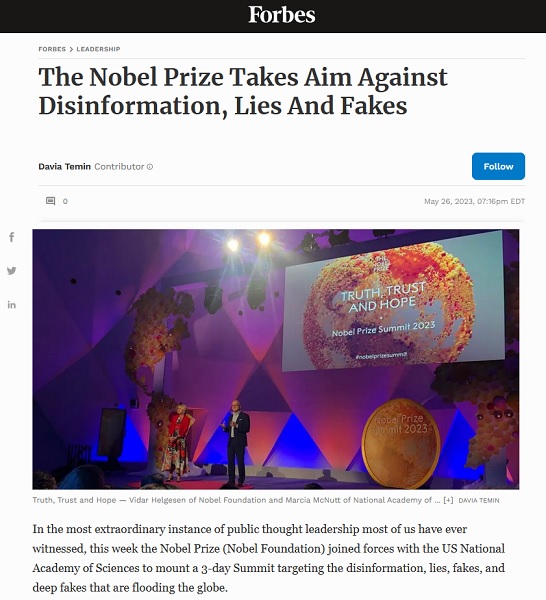
In the most extraordinary instance of public thought leadership most of us have ever witnessed, this week the Nobel Prize (Nobel Foundation) joined forces with the US National Academy of Sciences to mount a 3-day Summit targeting the disinformation, lies, fakes, and deep fakes that are flooding the globe.
The stakes could not be higher. From one-on-one ad hominem attacks, to the state-sponsored reputation destruction of political enemies, to the wholesale targeting of scientific findings, research and inquiry, disinformation campaigns are challenging our principles, truths — and souls. And, of course, social media and AI-enabled mimicry exacerbate the problem, putting our cognition more and more at risk. At their worst, they challenge our very understanding of reality, as well as our ability to trust anyone or anything.
Once there is no certainty to be found on the shifting sands of lies, trust dies a hard and ugly death.
So, who better to lead the charge than The Nobel Foundation and the National Academy of Sciences? In this three-day tour-de-force, titled “Truth, Trust and Hope,” they convened Nobel Prize laureates, notable experts, poets, artists, musicians, and even magicians to call out the problems caused by purposeful disinformation and truth destruction. […read more]
Exclusive: JPMorgan employees gripe about Dimon’s return-to-office edict
Nupur Anand and Lananh Nguyen, Reuters, April 27, 2023
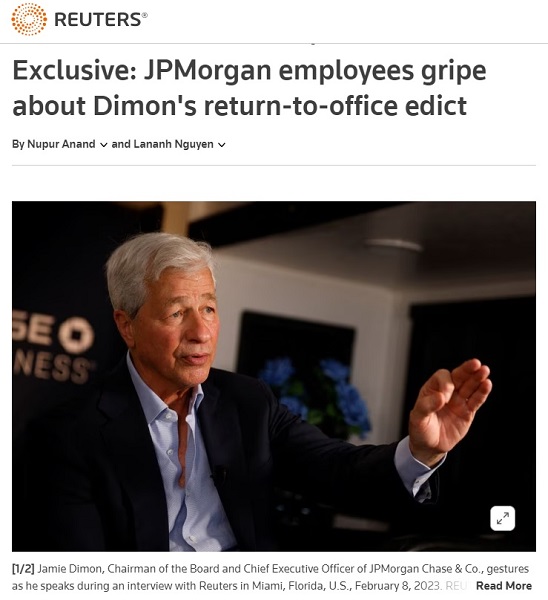
JPMorgan Chase & Co CEO Jamie Dimon sent a clear message to employees this month: get back to the office. It touched a nerve among his staff.
The largest U.S. lender’s employees inundated an internal messaging forum with criticism after its operating committee posted an edict entitled, “The importance of being together.” Some staffers pushed back, calling the message “tone deaf” and “divisive.”
In the nearly 700-word note on April 12 that sent ripples across the financial industry, the bank asked managing directors to return to the office five days a week and warned other employees working on hybrid schedules that they needed to show up three days a week or face consequences.
Davia Temin said employers may roll back pandemic flexibility and demand more in-office working as a recession looms and workers vie to keep their jobs.
“Working from home was introduced during extraordinary times and leaders have the right to change that, especially now as we are likely to be getting into a recession where profitability will be key,” Temin said. “It is not a God-given right, so it can be changed.” […read more]
Don’t Cry. Don’t Curse. Just Deliver the Bad News, Experts Say
Neanda Salvaterra, Agenda, April 21, 2023
 The message for CEOs when delivering tough news, particularly that hits employees in the pocketbook, is to communicate that they are willing to share the burden and take a pay cut, said experts. Something to avoid? Telling employees not to think about what to do if they don’t get paid.
MillerKnoll CEO Andi Owen faced pushback from the public this week for not displaying sufficient empathy and for telling workers to “leave pity city” during a Zoom call in March. Owen made her comments in response to employees raising concerns about staying motivated and potentially not being paid their bonuses due to the company’s experiencing financial hardships.
If a message has been damaging, then experts advise leaders to show contrition and encourage the public to recognize that executives are only humans who can make mistakes and deserve to be extended a bit of grace, according to Davia Temin, president and CEO of risk consulting firm Temin & Co.
“An apology is important. So is trying to change the conversation to ‘all of us are in this together,’” said Temin. She noted that viral moments can be especially tricky to navigate for women.
“The expectations of women leaders are different from expectations of male leaders; psychologists have said employees still expect a woman CEO to be a good mother,” said Temin. “In this instance and in any good organization, empathy and compassion goes both ways. I worry we are responding with anger as opposed to with understanding [and by] saying, ‘She must be under pressure. She’s got to make numbers for office furniture. People aren’t going back to the office as much, and she is trying to take care of her people.’” […read more]
Reassessing The Role Of Empathy In Tech: Between Zuckerberg’s “Feeling Your Pain” And Musk’s Creating More Of It, What Works For Layoffs?
Leadership, “Reputation Matters,” Forbes, November 30, 2022
“Kind, creative, and smart is the motto at Snapchat…Looks like that went out of the window right away when things started going bad,” wrote one worker after CEO Evan Spiegel announced the layoffs of 1,200 employees this year.
As more and more tech layoffs are hitting before the holidays, the real question is — are empathy and “emotional intelligence” truly sustainable as business practices in bad times as well as good? Or have we just been paying them lip service?
Over the last year, TechCrunch estimates over 85,000 tech sector workers have been laid off from 35 companies, with more to come. Twitter, Meta, Amazon, Stripe and Salesforce have each adopted different strategies on how to do it. But none of them have gotten it “just right” yet. And some have gotten it mightily wrong. […read more]
Southwest’s Silver Lining: Memories of Gaffes Fade Fast
Ryan Beene, Bloomberg, December 29, 2022
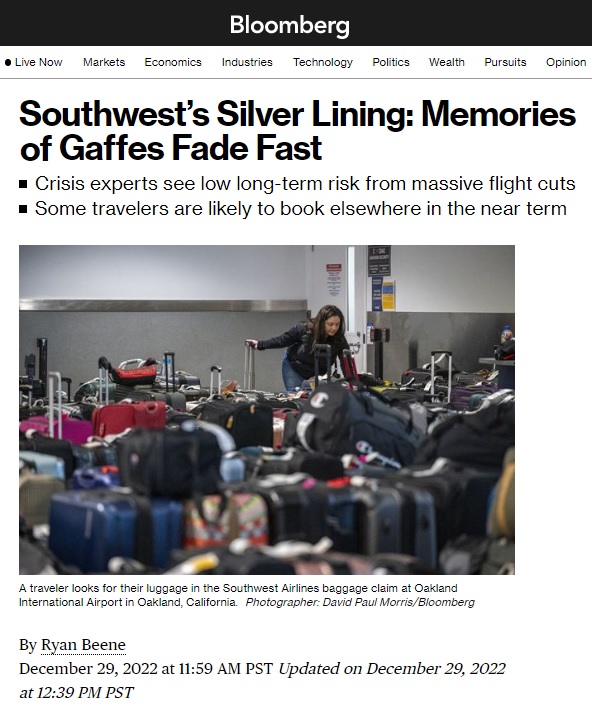
Southwest Airlines Co.’s 2022 nightmare before Christmas is unlikely to inflict long-lasting damage to the carrier’s reputation if management compensates customers and makes good on vows of operational changes, communications and management professionals say.
In recent days, social media has been flooded by angry Southwest customers after storms and shaky computer systems forced the airline, the largest domestic carrier in the US, to cancel more than 13,000 flights. Chief Executive Officer Bob Jordan has issued multiple apologies while employees work overtime to clean up the mess, which officials in Washington vow to scrutinize.
“It isn’t enough for even a well-meaning CEO to give his word,” Temin said. “It has to start a real series of events and change.” […read more]
Companies offer to help employees seeking abortions. It’ll be tricky.
Taylor Telford, Washington Post, July 2, 2022
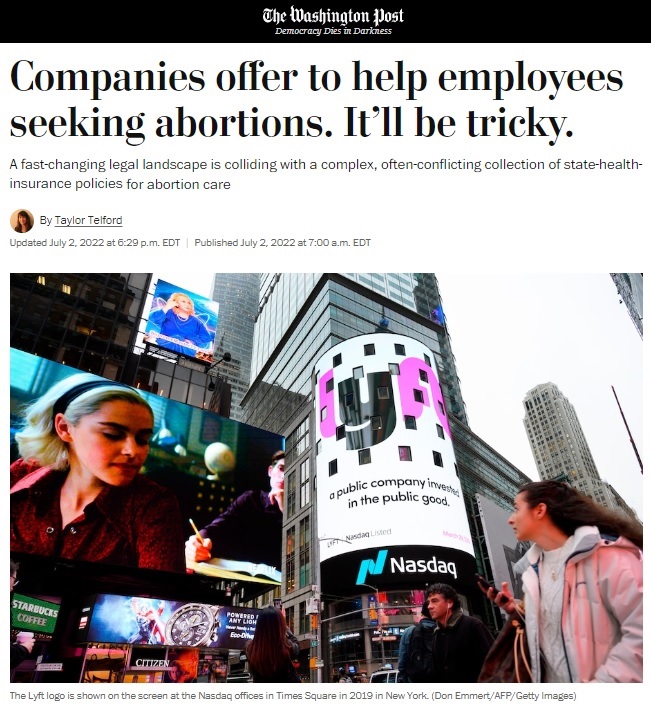
Corporate rules of engagement on social issues have shifted dramatically in the past few years, amid public pressure on companies to take stands on everything from police brutality and racism to climate change and voting rights. The fallout from the end of Roe v. Wade is forcing corporations to redefine their vision for social responsibility yet again, according to Davia Temin, chief executive of Temin and Company, a crisis management firm.
“It is illuminating who we really are, what we stand for, how we are changing, when we take a stand, and when we remain silent,” Temin said.
This time, corporations have largely avoided the sort of impassioned letters to employees and stakeholders that they usually put out while weighing in on key social issues, Temin noted. Instead some companies moved swiftly to expand their health-care plans despite the uncharted territory.
“What corporations are doing in a pragmatic manner is they are coming up with solutions for their people — because, of course, some of their employees are extraordinarily upset,” Temin said. “Instead of the persuasive and heartfelt letters, you’re getting action.” […read more]