



In the News–Corporate Governance
Southwest’s Silver Lining: Memories of Gaffes Fade Fast
Ryan Beene, Bloomberg, December 29, 2022
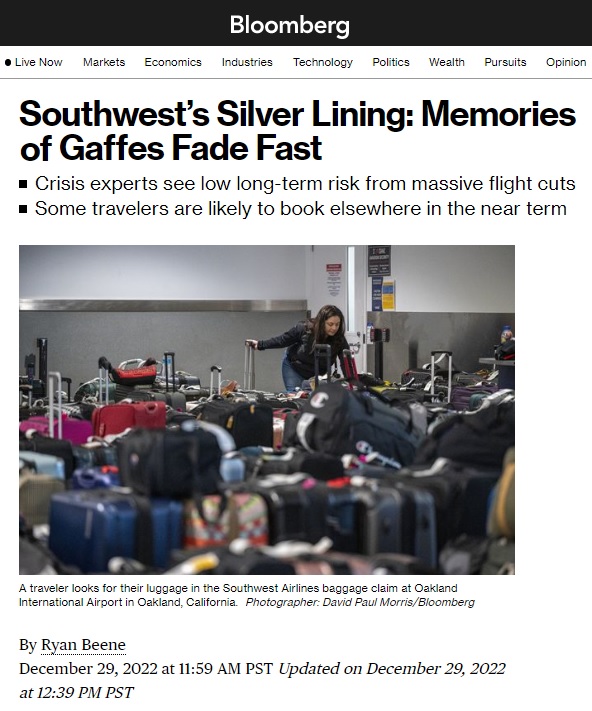
Southwest Airlines Co.’s 2022 nightmare before Christmas is unlikely to inflict long-lasting damage to the carrier’s reputation if management compensates customers and makes good on vows of operational changes, communications and management professionals say.
In recent days, social media has been flooded by angry Southwest customers after storms and shaky computer systems forced the airline, the largest domestic carrier in the US, to cancel more than 13,000 flights. Chief Executive Officer Bob Jordan has issued multiple apologies while employees work overtime to clean up the mess, which officials in Washington vow to scrutinize.
“It isn’t enough for even a well-meaning CEO to give his word,” Temin said. “It has to start a real series of events and change.” […read more]
‘A Failure of Governance’ — Boeing Reaches $200 Million Settlement
Lindsay Frost and Nick Muscavage, Agenda, September 30, 2022

Last week, the SEC settled charges against Boeing and its former CEO Dennis Muilenburg for $200 million and $1 million, respectively, for violating federal antifraud provisions related to making deceptive statements after two airplane crashes that killed 346 people in 2018 and 2019….
In announcing its settlement with Boeing and Muilenburg, the SEC drove home its claim that the aircraft manufacturer and its former CEO “failed to exercise reasonable care, resulting in public statements that were materially misleading to investors.”
The board is not often involved in company communications and doesn’t typically get a sign-off on press releases, but during a crisis, they should, said Davia Temin. […read more]
Companies offer to help employees seeking abortions. It’ll be tricky.
Taylor Telford, Washington Post, July 2, 2022
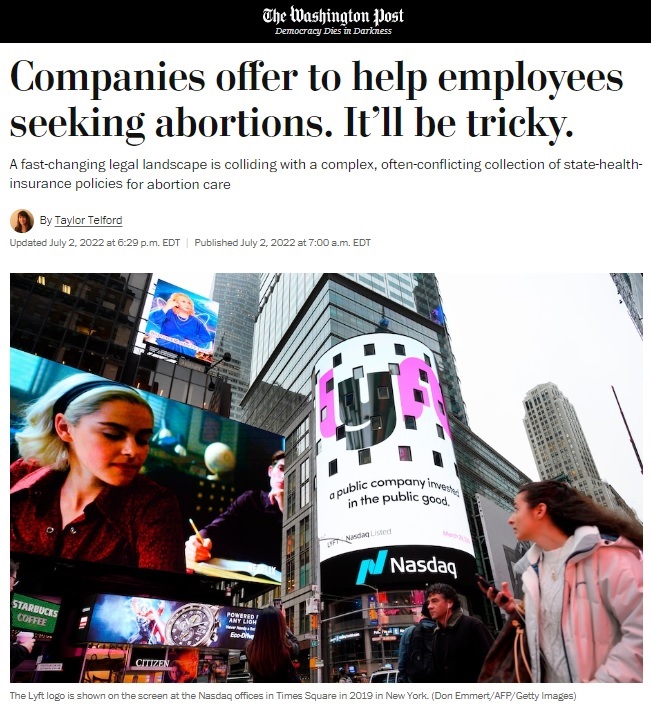
Corporate rules of engagement on social issues have shifted dramatically in the past few years, amid public pressure on companies to take stands on everything from police brutality and racism to climate change and voting rights. The fallout from the end of Roe v. Wade is forcing corporations to redefine their vision for social responsibility yet again, according to Davia Temin, chief executive of Temin and Company, a crisis management firm.
“It is illuminating who we really are, what we stand for, how we are changing, when we take a stand, and when we remain silent,” Temin said.
This time, corporations have largely avoided the sort of impassioned letters to employees and stakeholders that they usually put out while weighing in on key social issues, Temin noted. Instead some companies moved swiftly to expand their health-care plans despite the uncharted territory.
“What corporations are doing in a pragmatic manner is they are coming up with solutions for their people — because, of course, some of their employees are extraordinarily upset,” Temin said. “Instead of the persuasive and heartfelt letters, you’re getting action.” […read more]
Big Employers Say They’ll Pay for Abortion Travel After Roe Reversal
Jeff Green and Matthew Boyle, Bloomberg, June 24, 2022
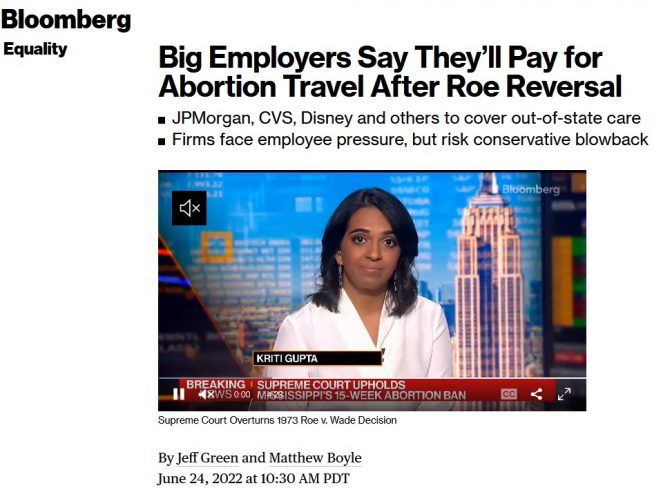
Some of the most recognized companies in the US indicated that they would extend coverage of out-of-state medical care, decisions that will cover more than a million employees after the Supreme Court overturned a half-century-old ruling that protected abortion rights.
Bellwether corporations from the worlds of finance, media, technology and health care said they would bankroll travel for workers who need access to safe, legal abortions and other procedures. The court’s decision overturned a decades-old precedent that backers say reshaped the modern economy by increasing opportunities for women.
“This is the hottest of hot potatoes,” said Davia Temin, founder of New York crisis consultancy Temin and Co. “Because companies are commenting on social issues more than ever before, the need to do the same around abortion is swirling through corporate America.” […read more]
Red Corporation, Blue Corporation? Corporate political speech becomes a board issue
April Hall, Directors & Boards, 2021 Second Quarter

After the January 6 attack on the U.S. Capitol, many companies announced that they would halt political contributions, either permanently or for a defined period. Some discontinuations involved a particular political party, some individual legislators and some were complete stops on all contributions.
In the age of “cancel culture,” when social media can circulate calls for boycotts to millions of people in minutes, some companies have begun to act quickly, with either their words or their wallets, to distance themselves from political controversy But there are other companies that have leaned in to a variety of public political positions. This raises the question: Are some companies becoming recognized as “blue” (Democrat-supporting) or “red” (Republican-supporting), or even “purple”? And are such associations good for a company, its shareholders and its stakeholders?
***
Crisis communications consultant Davia Temin says she often encourages her client companies to take apolitical stands.
During political or social upheaval, sometimes “corporations have to become the adults in the room,” Temin says. Corporations need to maintain some neutrality, “but it’s the difference between making sure that as a corporation you have a purpose and if you’re true to purpose.”
However, she doesn’t usually advise being outwardly political. She says there is a difference between having a “political point of view” and speaking out about a “behavior,” like systemic racism.
“I still think strict political lines are not the way to go,” Temin says.
She also doesn’t support the legal idea behind the Supreme Court’s landmark 2010 decision in Citizens United v. FEC, which said the free speech clause of the First Amendment prohibits the government from restricting corporations’ independent expenditures for political communications. The decision has been popularly associated with the notion of “corporate personhood.”
“Corporations are not people,” Temin says. “They are conglomerations of people, and they need big tents for their clients, employees and other stakeholders.
“That is different than having a sole political point of view.” […read more]
A Death at Jefferies Highlights Urgency of C-Suite Backup Plans
Jeff Green, Bloomberg Quint, March 29, 2020

Like all aspects of society, the rules of the C-suite are being rewritten under the pressure of a deadly pandemic. Professionals who help companies ensure leadership continuity say the coronavirus crisis has added a new urgency to their work. Some say clients are mulling whether to further isolate key executives; other clients have made private jets a given for top leaders who still travel; some have scattered top lieutenants across the globe as an added precaution. At least one is poised to hire a new chief executive officer largely by video interviews.
“Just as the virus cascades deeper into a population, so now too does your succession plan have to cascade into the population, into the hierarchy,” said Davia Temin, founder of New York crisis consultancy Temin & Co. And while bosses like JPMorgan Chase & Co.’s Jamie Dimon — a cancer survivor who just had emergency heart surgery — have a good plan in place, today’s coronavirus crisis means “you have to think of the succession to the succession.” […read more]
Temps at the top
Nancy Marshall-Genzer, Marketplace, April 23, 2019

Right now, the Trump administration has acting heads at the Defense Department, Homeland Security, the Small Business Administration, and the Office of Management and Budget. By the time you finish reading this story, there could be more. And that’s just the way President Trump likes it, as he told CBS’s “Face the Nation” in February.
“I like ‘acting’ because I can move so quickly,” he said. “It gives me more flexibility.”
It’s the kind of flexibility that’s increasingly on display in the private sector. Intel appointed Robert Swan as interim CEO last June. Last month, Wells Fargo announced that its general counsel, C. Allen Parker, would become interim CEO and president. J. Crew, Comscore and Herbalife have also brought on interim CEOs this year.
Davia Temin coaches interim executives. She says they have a tough job.
“You’ve got the title — almost,” she said. “You’ve got the responsibility — almost. You are acting as if you are the CEO, but when it comes to long-term strategy and planning and action and vision and mission, you don’t have that nod.” […read more]
‘A Tremendous Insult:’ Boardroom Leaks Irk Directors
Amanda Gerut, Agenda, April 1, 2019
Leaks of information about CEO hires, potential acquisitions and boardroom deliberations about executives accused of misconduct have become an increasingly acute concern as more activists, first-time directors and directors with varying business backgrounds join boards.
The spread of confidential information about boardroom discussions is an evergreen source of disquiet among directors. But as more boards contend with messy, difficult issues about company culture, for instance, dissent and rifts can sometimes lead to directors’ turning to outside sources to influence decisions. Staying abreast of group dynamics such as distinct majorities and minorities in votes, directors who feel their views aren’t being heard and general board dysfunction that can breed an environment in which directors might turn to the press or social media to air their views is important in maintaining an open — but confidential — atmosphere.
Meanwhile, the issue of information seeping out before a board has decided to formally communicate remains a frustration for directors.
Most boardrooms, like a therapist’s office or a confessional, are considered “sacrosanct,” says Davia Temin, president and CEO of reputation, risk and crisis management firm Temin and Company. However, that confidentiality can break down in certain situations. For instance, leaks can occur when a director tries to influence a board decision and isn’t successful. In frustration, a director might turn to the press to put external pressure on the board to get directors to vote a certain way. Activist investors may feel an allegiance to their firm or other outside parties, or founders could disagree with other board members and leak information to try to sway investors to their side. Confidentiality can also break down in a crisis, Temin says.
Still, “even in this world of social media and transparency, boardroom deliberations really do need to be opaque,” she says. […read more]
Amazon Execs Pool Stock in Revolt Against Board
Lindsay Frost, Agenda, January 11, 2019

A group of employees at Amazon are fed up with the lack of transparency and action the e-commerce giant has taken on climate change. So they decided to pool the shares given to them as compensation to file a proposal asking the company to disclose a solid plan on how to tackle the impacts of climate change. According to The New York Times, this is the first employee-sponsored shareholder resolution filed at a tech company.
This comes as employees begin to work more closely with shareholders to drive action on environmental and social issues impacting companies and the communities in which they operate. Experts predict that more employees, particularly those in the millennial generation, will begin to use their shareholder rights to bring these issues directly to the board. Boards should open the lines of communication to company employees and consider disclosing more about environmental and social issues, sources say.
“Employees are taking their employers up on their word to have a voice at the company, which isn’t just a good brand message anymore,” says Davia Temin, president and CEO of crisis consulting firm Temin and Co. “I don’t think this is going to go away any time soon. It’s probably going to become a staple of governance issues.” […read more]
Moonves Pay Punishment Caps Year of CEO Naming and Shaming
Jeff Green and Suzi Ring, Bloomberg, December 20, 2018
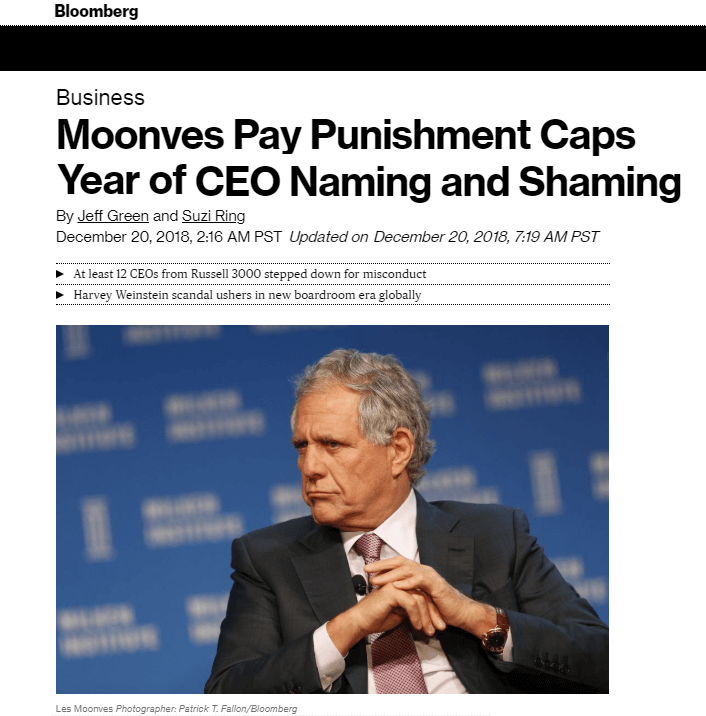
CBS Corp.’s decision to fire Chief Executive Officer Les Moonves and strip him of a $120 million payout caps an unprecedented year for naming-and-shaming in the corner office.
Corporate boards have been quicker to take action in 2018, now often announcing a CEO’s departure at the same time the misconduct was disclosed, said Davia Temin, founder of crisis consultancy Temin & Co. in New York. In October and November of last year, there were an average of 40 days between the first accusations and a firing. That has shrunk to almost zero now, she said, citing her database. […read more]
More News Articles